In the UK, the IT services market is not just booming, it’s a quickly evolving and growing landscape.
Mordor Intelligence reports that the UK IT services market is set to grow from $112.5 billion (c.£85bn) in 2025 to an estimated $166.56 billion (c.£125 billion) by 2031.
Given the additional spend of $54.06 billion (c.£40.85bn) over the next 5 years, what do UK MSPs need to do to achieve sustainable growth in this landgrab market?
This guide covers what I have learned building lead generation programmes for IT support providers and MSPs. Working out who you should actually be selling to, saying something a competitor cannot copy, generating conversations that go somewhere, and running a sales process that does not finish with you discounting to win.
If you compete on price and you are content competing on price, none of this will be much use to you.
Table of Contents
How market pressures are compounding these lead generation and sales issues
As reported above, by 2031 the UK market will be spending around $54.06bn a year more than it does today.
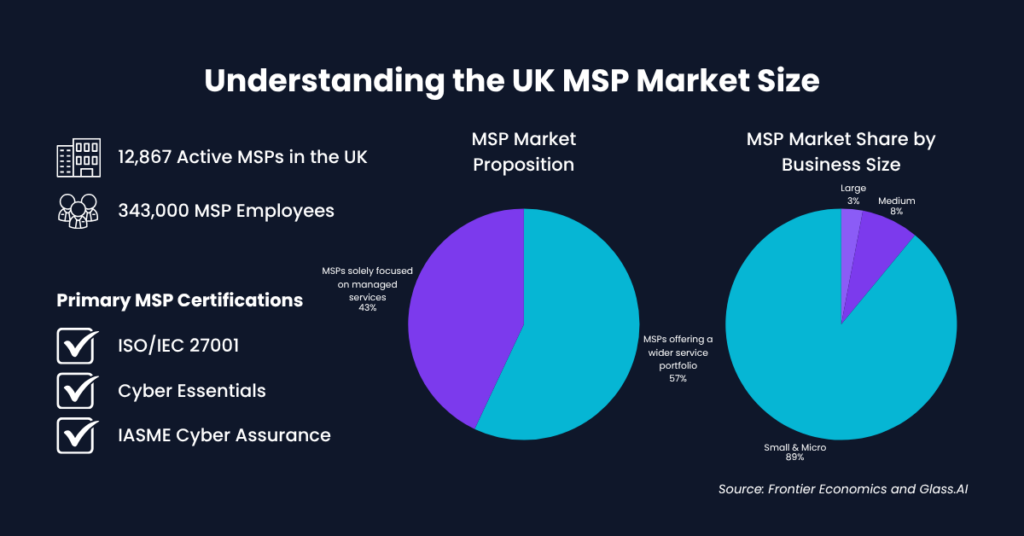
Frontier Economics’ and Glass.AI’s most recent Managed Service Providers Market Study (commissioned by the Department for Science, Innovation and Technology) shows the UK as having 12,867 active MSPs. What that figure does not tell you is how the MSPs are broken down, and who you’re competing against for that additional spend.
Of those 12,867 providers, 3% are large businesses, 8% are medium and 89% small or micro.
When looking at the MSPs, 43% have a dedicated offering. Managed services being the primary service, ‘with at least 75% of their employment or revenue attributed to managed services.’
The remaining 57% have a diversified offering; ‘companies that provide managed services as part of a broader portfolio with less than 75% of their employment or revenue derived from managed services.’
What does this mean for UK MSPs?
A competitive market where business owners have two options readily available to them.
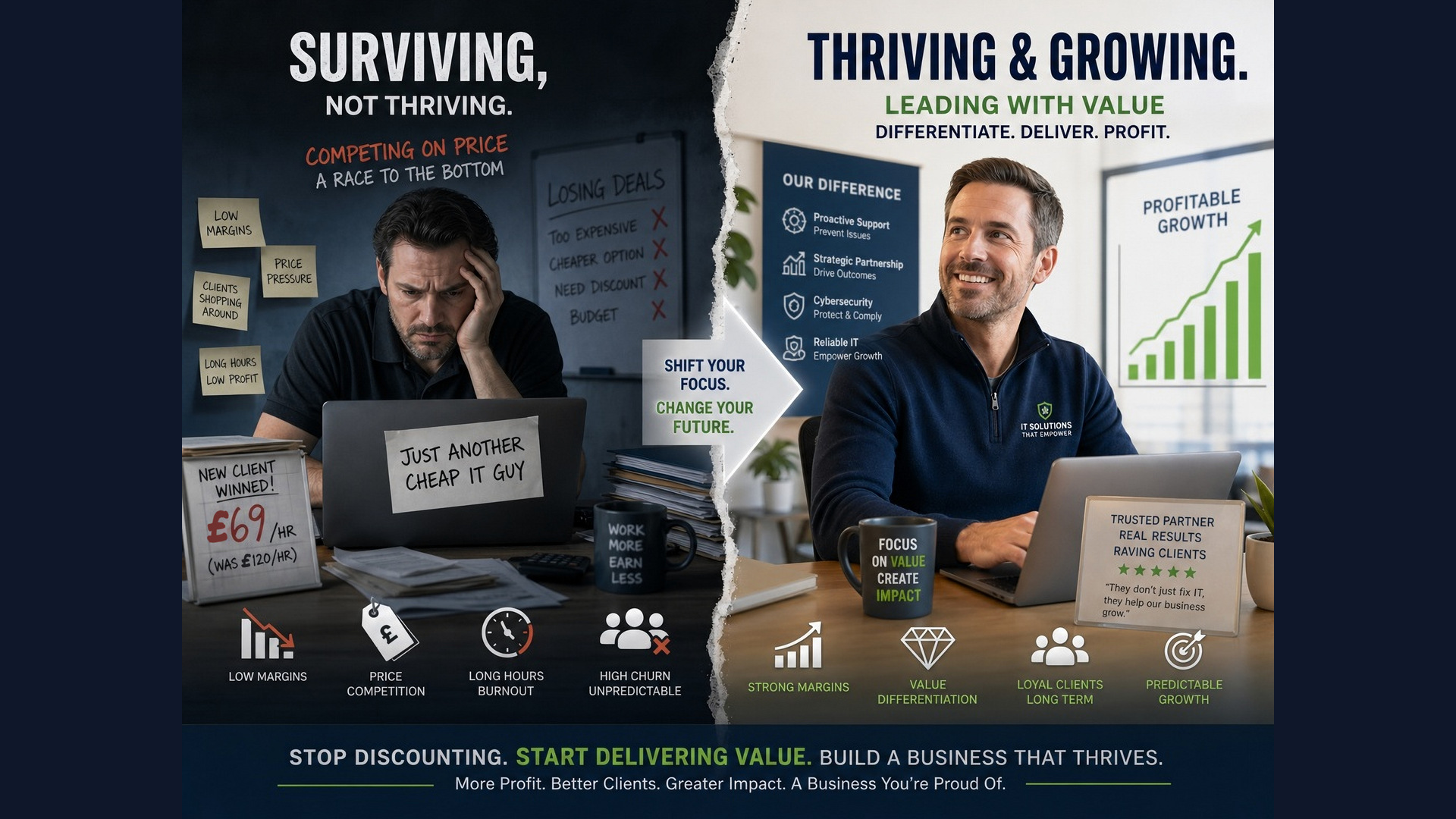
- Selling on price: A race to the bottom to win either non-profitable business, or new clients with tight margins.
- Differentiating their offering to win based on value and outcomes. In turn, forging valuable partnerships that work for both parties, solidifying long term engagements and allowing the business to run profitably.
Whether your offering is diversified or not, the simple fact remains. There is c.7,334 MSPs with a diversified offering, and c.5,532 where managed services are the primary proposition. Either way, the market is extremely competitive.
Understanding why buyers of IT Services are hesitant to change IT Support Providers and MSPs
Choosing an IT Support Provider has never been as important as it is now. The UK’s cyber threat environment is severe. The Government’s Cyber Security Breaches Survey 2025/2026 found that 43% of businesses experienced a breach or attack in the last 12 months.
The more useful part of the survey is what it says about how exposed those businesses still are. Only 25% have a formal incident response plan. Only 31% put cyber security at board level. Fewer than half, 47%, use any form of two-factor authentication. Just 36% run a VPN for remote staff, and the proportion of breaches that cost a business revenue or share value has more than doubled from 2% to 5%.
With the rise of AI transforming business operations throughout the world. More technology increases the risk factor. More software increases the likelihood of data breaches. APIs transferring data between different pieces of software further increases vulnerabilities. Data protection laws and regulations make the impact of data losses and breaches more terrifying than ever. Potential downtime means a less profitable operation, lost clients, lost opportunities. There is so much to consider, and that means that buyers need to feel safe.
“Better the devil you know” has never been more widely observed. An incumbent who is a bit slow on the phone is a known quantity. You are not. Switching means a migration, a handover, a window where something could go badly wrong, and a conversation with the board explaining why they changed. Weighed against all that, “we are cheaper” is nothing. Nobody risks their infrastructure to save 8%.
Which means your job is not to make switching look attractive. It is to make standing still look like the risk it already is.
When a buyer believes you understand what is at stake, believes you will be proactive, and believes their IT will simply work, the question in their head changes. It stops being what does this cost, and becomes: What happens if I never audit my current provider? What if we get hit and I did not ask the questions? What is the cost of not?
In shifting the conversation from price to a solution that they cannot say no to, you’re able to offer a premium service rather than competing on price. If you’re charging a premium on price, you’re increasing your profitability and you shift from survival to growth. You switch from the stressed business owner to the business leader you wanted to be when you first started your business.
By Understanding the Common Problems, You Can Now Sit in Your Buyer’s Shoes
Everyone nods at this. Almost nobody does it properly.
Having worked with a lot of IT support and MSP clients, I would say fewer than one in five can describe their ideal customer in a way that would let somebody else go and find one. “SMEs in the Midlands, 20 to 200 seats” is not an ICP. It is a filter on a data list.
A real one tells you why they buy, not just who they are. Start with the clients you already have and the deals you have already won.
Without the foundational understanding, you cannot differentiate from the competition.
It’s also important to note, that differentiation doesn’t mean changing your service offering, or your operational setup. It means repackaging your existing service in a way that is relatable for buyers, shows deep understanding and empathy toward their motivations, pain, desires and objectives. It means presenting in a way that allows them to understand exactly what they are buying and, most importantly, why they should pay a premium for your solution.
Your buyers will not pay a premium for the service, they will pay a premium to help them achieve their business objectives, not solve technical issues. By knowing your prospect, and their business, you can differentiate: An example is two buyers with the same technical concern, cyber security. One wants to streamline and grow their business from £2m to £10m turnover by expanding, the other wants to open several branches to offer better coverage. Both have a technical constraint, but by speaking to their business goal, not the technical concern you allow them to see how partnering with you makes sense.
Developing your Ideal Customer Profile
To build your ideal customer profile, I’d recommend looking at your existing customers and ask yourselves the following questions:
| What to look at | Questions to ask yourself about your existing clients |
| What is their business? | – What do they actually do? – What sectors are they in? – Who do they sell to? – How many employees? |
| Who did you engage with? | – What were their job titles and functions? – Where do they sit in the business? – Who engaged first, and who took over as it progressed? |
| Why did they engage with you? | – What prompted them to take the meeting? – What happened with the incumbent? – What were they hoping to get out of the first conversation? |
| What mattered to them? | – In the early fact find, where were they looking for a solution? – Were they after a genuinely proactive setup? – Or a cheaper version of what they already had? |
| What was wrong with their last supplier? | – What issues were they living with? – Response times? – Did they used to deal with the owner and now get whoever picks up? – Was there an outage, a data loss, a near miss? – Were they reactive when the client needed proactive? |
| Why did they buy from you? | The hardest one to answer, and the one you should never guess at. Think back. Did your proposal help them solve a business-critical issue, or was it and inbound where they said, “can you help with this?” If you don’t understand their buying motivations, you were lucky to win the business in the first place. |
The last question is the hard one, and most people guess at it. Do not. Ring three of your best clients and ask them. You will get an answer you did not expect at least once, and it is usually the thing your website does not say.
Once you have this, the firmographics fall out of it. Sector, size, structure, who holds the budget, who holds the pain. Your data gets tighter, your calls get more relevant, and the insight you earned in one business becomes the reason similar businesses take your meeting.
If the data is wrong, nothing downstream of here works. No matter how good the messaging may be.
What are the Common Problems IT Support Providers and MSPs Face When Trying to Win New Business?
Most IT support businesses in this country were started by an engineer.
Someone who was good at the work, got tired of doing it for someone else, and took the leap of faith. That background is an asset, and it shows. It is why your clients’ infrastructure holds up, why you keep the clients you win, and why your juniors turn into people worth hiring.
It is also why new business is hard.
Nothing in a technical career prepares you to position a business, build a sales strategy, or sit across from a stranger and ask for thousands of pounds a month. As a result, when sales conversations get tough, price is the easiest lever. Great, you’ve won the deal, but at what cost?
The question I ask is, is this winning? Or is this surviving?
Remember, in a competitive market, MSPs have two options:
- Differentiate themselves, selling proactive outcome-based support (highly profitable).
- Compete against the competition with reactive, cheaper alternatives (forsakes margin to win).
There cannot be a middle ground. There may be a market for both, but a middle ground cannot exist.
MSPs are judged on three things:
- Effectiveness
- Responsiveness
- Price
Developing Messaging on Differentiation, Not Price
The easiest way to understand how to develop messaging on differentiation, not price is to accept a hard truth. You cannot, usually, be effective, responsive, and cheap at the same time.
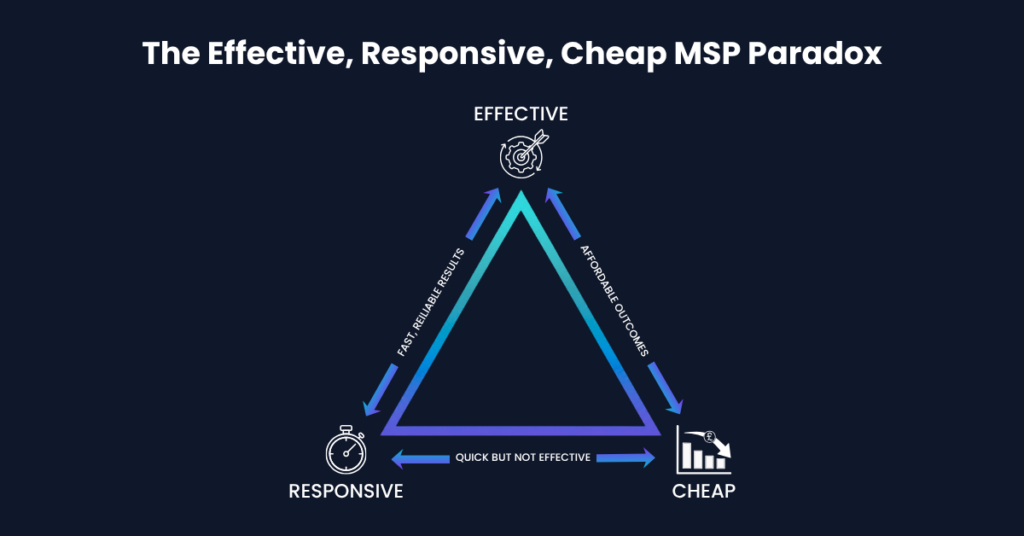
This is exactly what the triangle ‘The Effective, Responsive, Cheap MSP Paradox’ represents. It’s not just a visual, it’s a reminder that every MSP needs to make a choice about where it wants to sit in the market.
If you try to compete on price, something else must give. If you are cheap and responsive, you often sacrifice depth and quality. If you are effective and cheap, response times usually suffer. If your MSP is going to be positioned as effective and responsive (the most profitable option) then you are rarely going to be the lowest cost option available to your prospects. The triangle clearly demonstrates those who are responsive and effective in helping a business achieve its business goals, that price isn’t one of the parameters that you are going to be judged on.
That matters because most MSPs do not lose deals because they are poor at the technical work. They lost because they sound interchangeable. When every provider says they are “reliable, proactive, and customer focused,” buyers have little reason to choose one provider from another. In that scenario, price becomes the easiest point of evaluation. As a direct result, this pushes the conversation toward discounting, or offering more for less, rather than by way of adding value. If, however, you position yourself as a partner on the same side of the table, you keep asking the discovery questions digging deep, you go through business plans and explain where you sit, the conversation shifts.
In this scenario, if the prospect leans the conversation back to price, then don’t be afraid to say, “I’m confused, if your business goal is to expand, how can limiting users be relevant?” Naturally, use something that is relevant to the conversation!
The harsh realist is simply that when you’re developing your message, the best answer is to stay in your lane and own it. If your service is built around reducing downtime, improving continuity, strengthening security, and keeping businesses and their employees productive, then your message should reflect that. It should be noted though, that this must align with your prospect’s business goal, not the technical specifications. If it doesn’t, then dig deeper. Find out what their business goal is and demonstrate how you can help them to achieve their goal. If this can’t be done, the most profitable answer is likely to walk away from the opportunity as you will not be able to demonstrate enough value to deliver at margin.
That is where the triangle becomes useful for developing your messaging. It gives you a simple way to frame why your service is worth more without sounding defensive about price. Instead of trying to compete as the cheapest option, you can explain that the value of your service comes from the combination of effectiveness and responsiveness, and, that those things have a cost.
Remember: It’s not the service that matters though… it is how this service aligns with the business that will differentiate you against those selling the features of what you do.
This is where differentiation becomes powerful. A cheaper provider can always undercut you on price, but they cannot easily copy your positioning if it is built around a clear understanding of the prospect’s pain, risk and commercial goals. The strongest MSPs are not the ones trying to sound like everyone else at a lower retainer. They are the ones who make their value obvious, relevant, and hard to ignore.
The real job of your messaging if to help prospects understand why your service is worth more. That happens when you connect what you do to what they care about. Typically, this is less downtime, better productivity, fewer headaches, lower risk, and more predictable operations. When you do that well, price stops being the main question. The conversation shifts to value, outcomes, and trust.
That is where profitable MSP growth happens.
Engaging with Prospects Generating Sales Qualified IT Support Leads
You have an ICP and a message. Now you need people to engage with.
We run an omni-channel programme for our IT support and MSP clients consisting of telemarketing, email marketing and LinkedIn prospecting working together rather than as three separate campaigns, built around our 5 step lead generation process. Whether you build this internally or outsource it, the mechanics do not change. Here is how each channel earns its place.
What are the Benefits of Telemarketing for IT Support Leads?
When using telemarketing to generate IT Support leads, it’s important to recognise, and remember, that this is a competitive market. You’re entering a conversation that is shrouded in secrecy because of increasing threats, misunderstanding due to the complexity of secure IT infrastructure, and apathetic buyers: “If it isn’t broke, don’t fix it!”
To succeed, skilled Telemarketers and sales professionals must shift the conversation from “we do this” to “here is what we help businesses like yours achieve.”
Equally, your prospects do not want to feel sold or pitched tat. The art of selling via differentiation comes from engaging on a human level, acting like the curious student questioning deeply and looking at the current and future state possibilities.
B2B Telemarketing has, like most areas of sales, lead generation and marketing, needed to make monumental changes to remain a credible method of generating sales leads. Whilst you need to dig deep, you also need to be conscious of the fact that this is not a discovery meeting where you can dig even deeper. Prospects are not waiting for your call, and therefore you need to structure your prospecting activity in a way that is conversational, identifies the gap, but also respects their time.
Using AIDA when Generating IT Support Leads
AIDA is old and it still holds, if you remember that on a cold call your job is to qualify, and not to solve.
Attention. Lead with something they have not heard. Market intelligence, a pattern you are seeing across similar businesses, a question that cuts against how they currently think. Not “we are an IT support company based in the Midlands.” (Or anywhere else in the country!)
Interest. Get them talking about where they are versus where they want to be. This is where you find out whether the incumbent is working or just tolerated.
Desire. There is a gap and they can see it. Now they want to know what fills it, but not from you now, not on a cold call. This is what the meeting is for.
Action. Book it. Inside a week if you can. Momentum decays fast.
An opener that does the first part might sound like this:
[Intro yourself.] With recent data showing there are tens of millions of attempted cyber attacks in the UK each year, that’s an average of about 2,000 per business per day. 43% of UK businesses identified a breach or attack in the last 12 months. I was just curious as to whether your strategy is proactive or hopefully optimistic that you won’t become a statistic?
One insight, one question. Ten seconds and you know whether there is anything there.
Our Managing Director, Jason Greasley, borrows the old line for this: “People don’t want a quarter inch drill; they want a quarter inch hole!” Today, the quote is used by sales leaders to remind teams that technical buyers care about a specific transformation. For example: Instead of selling a database with a 99.9% uptime and auto-scaling (technical features), you sell a system that eliminates website crashes during holiday sales spikes, protecting revenue and reducing stress (business goals).
Email Marketing to Build Awareness Within Your Prospect Dataset, and Remove the Scattergun Approach
Email marketing remains a strong aspect of outbound prospecting. As a standalone method, it does have its limitations. You know yourself, you clear your inbox, and by the time you’ve cleared it there are another couple of sales emails in your inbox.
Much like telemarketing and the AIDA framework, you need to grab their attention almost instantaneously. Your prospects are busy, they haven’t got time for war and peace, they need impactful benefits, disruptive messaging and shared learnings and experiences. Ideally, in no more than 125 words… maximum!
As part of the lead generation activity, we undertake for our IT support and MSP clients, the email marketing plays two key roles:
- Building awareness within the dataset meaning that when calling, prospects are more familiar with the company name.
- Removing the scattergun approach to prospecting. With well crafted, impactful and disruptive messaging, we can encourage the prospect to click through to the website to learn more about what you have to offer. Those prospects who actively engage, showing intent, can then be prioritised for calling.
The cadence for prospecting then follows your prospects buying signals. Those who click through to the website get targeted first, followed by those who open, but do not click.
Increasing Touchpoints with your Prospects via LinkedIn
People engage in a way that suits them. Some talk; some write. My preference is the phone, but I’m not going to pretend that everyone shares it.
LinkedIn Prospecting earns its place when someone is genuinely less contactable via the telephone. When prospecting over the phone it’s always wise to ask yourself, if I call this prospect now are they likely to take my call now? If not, how can I increase the probability that they will? The best use of LinkedIn, in our experience, is after you have called and qualified who owns the remit for deciding upon IT and cyber security suppliers. Remembering that the average number of stakeholders in determining a change in supplier is 6.4 people, and if you align business goals rather than a product feature this number can increase. This is what makes not only the message relevant, but specifically how relevant it is to the person that will read it.
A connection request with a short note (no more than 300 characters given LinkedIn’s limitation) opens a door. Often, once it is open, the same person who never picked up will take your call.
You are not selling here. You are starting a conversation. Send a message not about how good you are, but asking what their aspirations are, otherwise, you’ll get nothing.
Refine Your Sales Process to Win Profitable New IT Support and MSP Clients
Being liked but not valued will get you a nice meeting and no order.
Without deep discovery, identifiable urgent needs, benefits tied to what the buyer wants from a business perspective rather than a technical fix, and clear differentiation, your sales process is roulette.
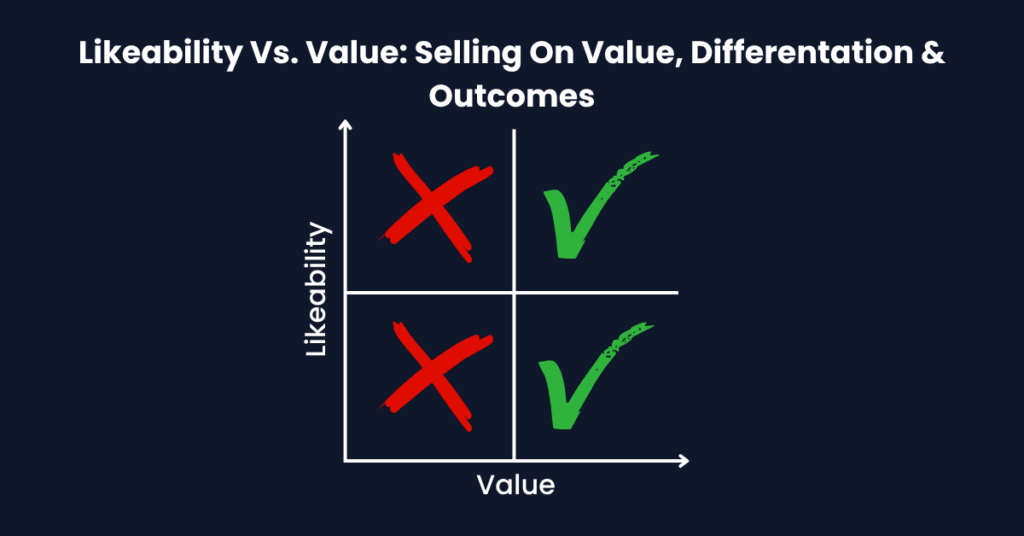
Liked with no value does not close. Value without being liked closes more often than people expect. Liked plus value is obviously where you want to live, but if you are forced to choose, choose value.
That is worth sitting with, because most salespeople spend their effort on the wrong axis. They give the meeting to rapport and the last five minutes to the problem. Turn it around. Likeability is not built on small talk anyway. It is built on a buyer walking out feeling like you understood their business better than the last three people who rang them.
Deep Discovery
My discovery calls run about 45 minutes. I am to speak for seven of them.
Th rest is being the curious student. Question everything, take nothing as a finished answer, listen properly. What are they trying to achieve? What is wrong with the incumbent? What happens to them personally if this goes wrong?
The curious student does not accept the first answer. “Response times are a bit slow” is a current state answer, masking a deeper problem. Slow how? Since when? What did it cost you last time? What are you looking to achieve and how does response time or time to resolve impact upon that?
Salesperson to salesperson: I would take a call where I understand exactly how I can help and the prospect felt heard, over a call where I found out what they did at the weekend.
Identifying Strong and Urgent Needs
Find at least three.
Not three problems. Three needs the buyer is motivated to fix now. Without them you will end up back at price, assuming you get that far. With them, you can build a proposal around what they told you matters and demonstrate value in the specific place it will land.
That is the whole return on a good discovery call.
Forget What You Do, Lead with Benefits That Clearly Evidence Value
No one wants you to focus on the features. They want to understand “what’s in it for me?”
A few examples where you can show value through benefits, whilst justifying a premium rate could be:
Example 1
Feature Led Statement: “We employ highly skilled technicians.”
Reframed, Benefit Led Statement: “We pay above market rate for our engineers to ensure we attract the best possible talent, which means, we’re able to be highly responsive, proactive rather than reactive and most importantly, effective. As a result, the clients we’re working with now are seeing a reduction of downtime, and significantly increased protection against cyber-attacks.”
Whilst generic, this is a statement of benefit. This would be even better if you understood where downtime costs are of if this is even a pain point to the client.
Example 2
Feature Led Statement: “We spend a significant amount of time actively working on your cyber security strategy to ensure you’re fully protected.”
Reframed, Benefit Led Statement: “Our team are an extension of your business, proactively monitoring threats around the clock. As an extension of your team, our primary focus is on ensuring that you’re fully protected at any time of the day, which means you can rest easy knowing that your threat exposure is minimised.”
Whilst again generic, if you found out that your prospect works international time zones or is an industrial company that needs to manage remote dashboards 24/7, being able to support them when they need rather than when you are in the office will have even more relevance.
Moving away from discussing what you do, to how you add value, with clearly defined benefits allows your prospect to instantly see the advantage in working with you. Equally, by adding an additional level of justification as to why your rates are higher than that of a competitor makes it harder for the prospect to negotiate on cost.
If they start negotiating on cost, you can assume they haven’t seen the value in what you bring.
Identify Objections, Don’t Hide from Them. Face Objections Head On.
It’s understandable that you don’t want prospects to have a myriad of objections. But whether there is one or six, you need to know what they are, and you need to know while you are in the room.
When presenting your solution, you need to check understanding and why they would not move forward with your solution over a competitor’s.
By drawing the objections out of the prospect in a meeting or call, you can understand their concerns and alleviate them.
For example: If a prospect says something along the lines of “I really like what you have to offer, but you’re coming in 30% more expensive than the other proposals that I’ve received.” Then you have not understood their goals. They will not look at price if you talk about helping them achieve their business plans. You are providing a business solution, not a piece of software or a standard service, if this is all you have to offer, then you will be challenged on price as another provider is offering the same feature, rather than a business solution.
Your following statement, “I’m confused, when we first met you told me the priority was getting security managed proactively so you were not finding out about problems after the fact, and that continuity mattered because of the contract with [client name]. That is the specific thing we are built for. It is also why we pay what we pay for our engineers. The clients who have moved to us from a reactive setup are seeing [your figures*]. Is that still what matters most here?”
*One thing about that number. Use a real one. Go and get it from your own client base before you need it in the room, because an invented statistic is worse than no statistic at all. It is the fastest way to lose a technical buyer, particularly if they fact check your statement.
Overcoming objections is not about using ‘clever’ sales tactics. It’s about re-checking your understanding, the prospects understanding, and demonstrating your value.
Control the Sales Process Throughout: Present Your Solution and Deliver Clear Value Statements
If there is one thing in here worth acting on today, it is this.
Book a session to present your proposal rather than sending it for them to read alone, form objections you will never hear, and come back with a number. Presenting it means you check understanding, confirm it is aligned with their goals, and get the objections where you can address them, and if need be, reframe the solution, especially if you are engaging with a member of a complex decision-making group.
Sending a proposal is handing over control. Presenting a solution is keeping it. Same document. Completely different outcome.
Use Learnings from your Lead Generation and Sales Process to Further Generate More Sales Leads, Increase AI Search Visibility, Improve SEO and Create a Continual Loop of High-Quality Sales Leads
By bridging the gap between sales and marketing activity, you create a powerhouse that allows you to directly communicate with your prospects based on what they are saying, and what market intelligence you’re gathering.
When prospecting, you are engaging in peer-to-peer conversations with senior decision makers. Whilst the primary objective should always be to generate new sales opportunities, your secondary goal should be gathering contacts, contact information and intelligence. By storing this information in your CRM, your marketing team can use the notes from your conversations to generate high-impact content that is directly related to the conversations being held, objections that may arise, and incumbent solutions.
This continues into your sales process. During your discovery calls, make a note of pertinent information that can be used for content creation.
In creating authoritative content based on the questions being asked throughout the sales process, you can almost guarantee that other prospects are searching for this on search engines and LLMs. If you web, marketing content and FAQs are directly answering these questions, not only will your search results increase, but also citations on Google’s AI overview, ChatGPT, Gemini, Claude and other LLMs.
This means that not only are you helping prospects engage directly with you, but you’re also increasing the volume of inbound leads naturally from the leads you’ve already generated.
Key Takeaways for Generating IT Support Leads, and Winning More Profitable Business
- The UK MSP market is competitive, which means competing on price alone is rarely a sustainable way to grow.
- The strongest MSPs do not sell support as a commodity, they position themselves around outcomes, reliability, and business value.
- The Effective, Responsive, Cheap paradox shows why trying to be everything to everyone usually weakens your offer and pushes the conversation back to price.
- To win better fit clients, you need a clear ideal customer profile, a strong understanding of buyer pain, and messaging that reflects what prospects care about.
- Lead generation, discovery, and marketing should all work together, so every conversation helps improve the next one and strengthens your pipeline over time.
Interested in Auditing Your Lead Generation and Sales Process?
If you’re ready to build a more profitable MSP that attracts the right clients through differentiation and value, rather than price, book a sales audit with one of our Growth Strategists today.
We’ll review your growth objectives, identify where we can support your business, and develop a bespoke lead generation strategy aligned to your plans for sustainable and achievable growth.
About the Author
Ben Miller, Director of Growth Strategy works with The Lead Gen Specialists’ clients to build lead generation strategies that support profitable growth. With 18 years’ experience in sales, marketing, and lead generation, including 10 years in sales and marketing leadership, Ben helps businesses improve messaging, generate better quality leads, and strengthen sales performance. He also works with teams across the UK on sales training, coaching, and mentoring, helping them turn strategy into measurable results.